Wednesday, November 22, 2006

Claus Film a Work of 'Art'

So long, Tim Allen. There's a new (old) St. Nick in town.

And he's packing Christmas cheer, ready to kick some serious martian derriere.

I'm referring of course to one of Hollywood's most under-appreciated holiday gems: Santa Claus Conquers the Martians (1964).

The movie title basically speaks for itself. What more can a girl say about a film so terrible — so kitchy — that you simply cannot look away? By this hopelessly flawed design, Conquers is the sort of film that derives its "greatness" from the simple fact that it appears to be intentionally awful.

Or else the writer and director hoped to make a political statement by aligning the Martians with the Soviet Union (certainly there are faint parallels), and were otherwise terrible filmmakers. Either way, the final product was so awful, it's funny.

The word "sprezzatura" comes to mind, but then dissipates almost as quickly as it appears. That is to say, Conquers isn't so much an art house film replete with "careless grace" as it is a B Movie scattered with careless comedy.

So much so, in fact, that I wouldn't hesitate to recommend parents forego the newest addition to the Santa Clause epic and instead rent this one. I mean, this film is about the kidnapping of Santa Claus by a Martian commander who wants to bring "Christmas" to his own, hapless planet. What's not to love about that?

(Santa Claus Conquers the Martians, for the record, has one of the lowest ratings in IMDB history.)

I'm reminded of a trip I once took to the Museum of Bad Art. I had hoped that the artwork there would be so wretchedly awful, it'd be funny. But, ultimately, many of the pieces there were simply mediocre paintings that weren't so much "bad" as they were reminiscent of a community center art class. In other words, the art wasn't bad, per se... but I was certainly disappointed. I walked away realizing there's a difference between a Museum of Bad Art (this museum's name), and a Bad Museum of Art (what it actually was).

But if a true Museum of Bad Art existed — and they were looking for a video installation — I'd recommend Santa Claus Conquers the Martians without hesitation.

It's just that the film is so bad... it's good.


Addendum: After perusing the MOBA's new website, I've come to realize they've substantially upgraded (downgraded?) their collection. Might actually be worth a visit now, if you're ever in the area.

Tuesday, November 21, 2006

These Walls Talk

So I'm sitting here at 11:20 p.m. listening to my neighbor's music when suddenly it hits me:

I'm ready to move.

Thursday, November 16, 2006

Silly Borat, Tricks are for Kids

When I heard that two of the three frat boys seen in Borat: Cultural Learnings of America for Make Benefit Glorious Nation of Kazakhstan (2006) were suing the film's star (not to mention the production company), I scoffed.

I mean, sure, they embarrassed themselves on-screen by saying sexist and racist things. And, sure, they thought the "documentary" was going to air only in Kazakhstan.

But they said what they said, unscripted, and they knew they were being recorded. It's not comedian Sacha Baron Cohen's fault they cannot control their tongues (even if the production crew did, as they boys allege, ply them with alcohol). Mel Gibson wishes he could take it back, too, but at least he's not suing the police officers who reported his verbal backwoods shenanigans.

And then I heard about some Turkish guy who's suing Cohen for "stealing" his character. Turns out this guy might have a case: he started a (now defunct) website in 1999 called ikissyou.org. This personal website began as a legitimate homepage, but its creator quickly became an "online celebrity," when his broken English, silly pictures (him sunbathing, him playing ping pong) and pleas for American women to "come stay please at my home" earned him a cult following. He was sharp enough to pick up on this fact, and so played along with it... further transforming his site into a comedy of errors.

If he can prove Cohen stole his "character" as the inspiration of Borat, then he deserves to be compensated. Otherwise, I think Cohen could make the case that the accuser isn't the only man in the world with broken English and bad taste. Not to mention, it's a sad but true fact in the creative world that many of our best ideas are "stolen" (or, at least, independently developed by someone else, and then put to good use before we get the chance).

But this newest lawsuit. Well... this one bothers me a bit.

Turns out parts of this film that I assumed were staged were not entirely so.

And that includes the opening sequence, where "Borat" wanders around his Kazakh village, introducing his family and exposing the town's poverty for all the world to see.

Because of what happens in this scene, I imagined the people were "actors" being compensated for their trouble. Turns out they weren't actors at all, but rather a group of impoverished gypsies in the Romanian village of Glod. Apparently they were led to believe they were taking part in a documentary about poverty, and were paid between $3.30 and $5.50 to do demeaning things.

[Sure, you can argue that's more than they would've had — it's true, and that's precisely why they did what they did — they needed the money. But to see an entire village taken advantage of like that? It's disheartening.]

Is it wrong of me to see a difference between the drunken frat boys and the villagers who live without running water?

Granted, I realize compensating these villagers after-the-fact is a slippery slope of sorts: if Cohen were to pony up more cash, would he then have to equally compensate everyone else who appears in the film?

I imagine, legally, that's a difficult line to draw.

Cohen and company could've avoided all of this up front by being honest with the Romanians (in comparison to other scenes, these people weren't being caught "candid" on camera) and paying them more money (compensating them as "actors" rather than people merely making appearances). Granted, they may have still asked for more money after they realized what a huge success the film turned out to be, but at least that would have had less cause for recourse.

But this newest case infers these things weren't done. I'm waiting for more facts to come out, but if these allegations are true — and it appears as though they are — Cohen owes the people of Glod one enormous goodwill gesture.

Wednesday, November 15, 2006

The Facts about Fiction

Since watching Stranger than Fiction (2006) this past Saturday, I've come to realize just how easy it is to review a film you either love or hate.

The hardest reviews to write are ones like this: films you enjoyed, but not as much as you'd hoped. Films that lure in the literary types with interesting plot twists, only to have a few kinks in the intellectual follow-through.

I mean, I liked this film. I really did. But where as the minds behind Adaptation (2002) — director Spike Jonze and writer Charlie Kaufman — genuinely twisted my brain right in with that film's cute-but-complex plot, Stranger than Fiction requires a sort of suspension of disbelief that's a bit more difficult to swallow (I compare the two here because both films position "writing" at their core).

And, no, I did not expect to find the plot "realistic," per se. I had just hoped for a little more assistance along the trail to make believe.

But that's not to say this film isn't compelling. Quite the contrary: Stranger is about an IRS agent named Harold Crick (well-played by Will Ferrell in his least comedic role to date) who lives his day-to-day as so many folks do: he's caught in a routine that serves only to propel him further into a sort of quiet loneliness. Topsy turvy enters into his world, however, by way of a woman's voice.

He hears this voice from time to time throughout the day, and quickly realizes it's talking about him: the voice beautifully narrates his very movements; his thoughts; his hopes. Needless to say, this disturbs Crick... particularly when the voice forecasts his "imminent demise."

Crick makes it his purpose, then, to seek out the narrator in an attempt to spare his life from this omniscient thrashing.

I was amazed by how well Crick handled this voice, all things considered. He never seems to lose faith in himself, even after a psychologist offers up the expected "schizophrenia" diagnosis. In this respect, the film explores notions of comedy, tragedy, character and various other literary devices.

And for that, I enjoyed the film. I thought Ferrell was great, as were the other "big" names: Emma Thompson (the voice in his head), Queen Latifah (the voice's assistant), Dustin Hoffman (literary critic) and Maggie Gyllenhaal (renegade baker/tax evader), etc.

But no matter how much I want to give Stranger a smashing review, I keep coming back to this: something was missing. It was cute, with meaningful undertones. And I was initially drawn in with the allusion to literary theory, and it's exploration of comedy, tragedy and story-telling.

But I think that may very well be where it falters. It lacked the mind-bending that made Adaptation such a joy to watch, as well as the framework that made the town of Seahaven so believable in Jim Carrey's The Truman Show (1998).

You see what I mean? I have no problems suspending disbelief when there's no hint of reality; but when you intermingle the two, you've got to give the audience more foundation.

Previews for this film had me hoping I'd walk away with an altogether new apprecation for Ferrell, as I did for Carrey after Truman.

And though I wasn't salivating for Stranger than Fiction as I did for The Truman Show or even Adaptation, I've got to admit that I was a fan of Ferrell's work long before this film (I can't say the same for Carrey or Nicholas Cage — the star of Adaptation).

But will Stranger function as a transitional role for Ferrell? Now that he's done a "more serious" comedy — in comparion to the uproarious humor that marks Anchorman — does that mean we'll soon see him in grab-your-kleenex dramas?

I certainly think he's capable. But, man, if he hasn't found a niche...


Monday, November 13, 2006

Gesundheit!

The Setup: Two Catholic priests rise up from a nearby table, having just finished their lunch at the local bar and grill. Their presence spurred a conversation about Catholicism between a man (raised Catholic) and me (raised Protestant).

As the two priests walk away, one of them sneezes.

Man to Priest: Bless you.

[Exit Priests]

***

Me to Man: Wait a minute. Did you just bless a priest?

Man: Yes.

Me: Is that allowed?

Man: What do you mean?

Me: I mean, you just blessed a priest.

Man: Well, the other priest blessed him too.

Me: Exactly. So the blessing was pretty much taken care of by someone of equal status. [Stealing his Bloody Mary and biting into the celery.]

[Man, shrugging, taking back his Bloody Mary.]

Me: No, really. I'm curious. You were raised Catholic, so you'd know better than I. You told me once that only certain people were allowed to "bless" certain others — like only Cardinals and above can bless an entire crowd. So tell me... do you have the authority bless a Catholic priest?

***

OK, so I don't know where the conversation went from there, but I'm pretty sure my question went unanswered.

And while I initially asked the question to underscore the irony/comedy of an ordinary sinner blessing an ordained priest, I'm actually quite curious.

So... can any of you tell me? Can any plebeian bless a priest, or would doing so be against protocol?

Friday, November 10, 2006

OK, So Maybe I'm Simply the Worst

Recently, I gave some thought to submitting a few poems to a literary magazine. The deadline was (is) fast approaching, so I spent some time last weekend looking over some old stuff.

I subsequently decided against submitting. You'll see why once (if) you read the below. I've opted to post this one simply because it explores, in part, the same "window reflection" effect I discussed in a recent post.

Interesting to stumble across this old piece and revisit that same fascination, four years removed... even if is does substantiate my online moniker.

Modern Prometheus


Accursed progenitor!... Accursed fornicator! ~Hamm in Samuel Beckett's Endgame

Enter Boy
He slides the paper across the counter-top,
white smile against dark skin, eyes barely visible
over the ledge, his sketchings on one side,
imagined words on the other: shapes, notions, the
letter "A" scrawled like tree limbs with pink
highlighter; four wheels and a box, headlights
like tin cans, a piece of paper with three
perfect words beneath fluorescent waves

Please pray for ...

A page torn from a Sunday program.
Scrap paper
Ancient thoughts, new form
Unsteady hands, learning the
art of reproduction, symmetry, and reason.

Please pray for...

Recycled smiles
purpose
imagination

Hands that stretch into fists
Laughter like a dying wind;
Intelligence, consequence,
and spiritual cul-de-sacs

Watch the boy walk away
Smile stuttering into a sigh

Six feet in twelve years—
Hand dragging charcoals
across the canvas, mother
in tears, dark faces blurred
by excessive contemplation

Veins drawn, the pulsation,
the explosion that comes
with time, the gap between
then and now

that widens

experience a narrow bridge
with no bottom

like legs spread into
the cold horizon

Reflect

In the beginning, all was
dark. And God said let there
be light, and there was light.

Today I flip the switch

watch you come and go,
reflections build in the glass
transparent until the ghosts
approach

closer and closer

my own reflection growing
as you near

my creation,
completion
in a stranger

unseeing anything
but the hills and then
you, with your hands and
your scowls and your grimaces
and your scents: the alcohol, the smoke,
the cologne

the fast food that bleeds into your
clothes

the human mind is a mystery
when we are first created

all is completion
when we are young

but we never stop to consider
any of these things

only the color of the sky and why, mother,
oh why...

you approach, closer and closer,
I see myself as you near
tuck the scrap into my book
and breathe in the smell of you,
nostrils flaring into the corner
of a stale grin

To Sum Up

Please pray for...

One reaches Nirvana by breaking
out of the cycle

Please pray for...

Wellbuturin for anxiety.
Celexa for depression.

(Take both for balance)

Please pray for...

In academia, one opens not a
can of worms but

pandora's box

Please pray for...

And on the first day, the world was a
satisfying yawn of affection

Please pray for...

And on the second, he pleaded with his
god, who rejected him,

Please pray for...

And on the third, a terrible emptiness rose
into the crux of his eyes

Exit Boy

His right hand arches across the canvas.
Beneath the flesh he battles
the monster of his own


creation

Thursday, November 09, 2006

Prairie Takes Some Getting Used To

Prairie Home Companion (2006) was hard for me to get into. And whether it was just a slow start — or my general mood — it's only just now (four days after watching it) that I'm really starting to enjoy it.

I found the second half to be substantially more interesting, and more comical, than was the first. I think what was missing, for me, was a previous relationship with the Public Radio show of the same title.

Afterall, Prairie Home Companion, the movie, is a fictional story about the "final broadcast" of the popular radio variety show. I believe the radio show is actually alive and well and — though the movie borrows from the show's skits, guests and the like... Garrison Keillor — the "real" radio show's creator/star, and the writer of this movie — is the primary link between the radio show and the film.

It's for this reason that the film bears a sort of resemble to mockumentaries, though we're never once led to believe that the "characters" have any idea they're being filmed (which differs substantially from most mockumentaries). At one point one character — the man responsible for the show's cancellation — even notes that he "wishes" he'd thought to have the final show taped for posterity's sake.

The story goes a little like this: the (fictional) stars of the (real) radio show all gather for their last hurrah; their station has been purchased by a big company who's revamping everything, and cancelling the show. Backstage they're all clearly nervous about their lives post-PHC, and frankly a little sad to close this chapter of their lives. On stage, various performances (throw backs to performances on the actual radio show, I'm told) continue and various other "monkey wrenches" are thrown into the mix.

Death also makes an unusual appearance, and presents one of the more compelling aspects of the film (insofar as we get the feeling that — try as we might — there's no way to separate comedy from tragedy in that bittersweet circle of life).

In short, I found this "comedy" to be markedly depressing (but not in a way typical of most black comedies). And because it's also slow moving (as are most Altman films), I had a difficult time really enjoying myself. But, as I mentioned in this review's leading line... the more I think about Prairie Home Companion — and the more I write about it — the more I like it.

It's that sort of film. The sort that's somewhat touching; somewhat comical; somewhat insightful; somewhat depressing; and, yes, even a tad boring. It's a little of everything (go figure, it's based on a variety show), none of which struck me as being altogether interesting until long after I ejected the disk from my DVD player.

Truth is, I never quite know what to say about Robert Altman films. I always find them intellectually compelling on one level, and yet altogether boring on another. And, yes, I know. I should be ashamed of myself for dissing the much-reverred filmmaker.

But I can't help it. You're reading a review by the same girl who nearly boycotted the 2001 Oscars in protest of all those accolades heaped onto Altman's Gosford Park (a film that, again, I only enjoyed casually after-the-fact).

Oh, well. There's no question people like what he's doing. I guess, in a way, Altman is a little like the tortoise in that proverbial race with the hare: he keeps a slow, steady pace and yet somehow always comes out ahead in he end.

Tuesday, November 07, 2006

Bacterial Election

Election day is here, and I couldn't be more thrilled.

And, no, it's not because this will be my first time voting in this state.

Nor is it because I'm one of millions out there hoping for a House flipping that will transform our Commander-in-Chief into a lame duck.

Rather, my excitement is powered more so by my desire to have those wretched advertisements (television and otherwise) put to a halt. The attack ads have been so vicious this year, I've found myself rolling my eyes to the tune of every political party. In short: with so much mud being slung around, even I feel dirty.

In many of the races here, voters only know of the candidates what their opponents have said. In which case, we're literally choosing the lesser of two evils because we haven't heard a single good thing about anyone.

For the first time in my life, I'm going to vote for the "little guys" who don't have a chance in at least two races, just to contest all of the negative energy I've had to endure at the hands of big money yarn spinners.

Does that mean the little guys wouldn't have turned up the productivity on the "NEGATIVE AD" machine if they had the money?

They probably would have. But at this point... I don't really care.

Here's what we're dealing with: the two "main" gubernatorial candidates both have very low approval ratings (think "President Bush" low). And yet the incumbent has a 14-point lead over his opponent.

He was asked what he thought about his low approval rating, and he said something to the effect of: "What do I have to be offended about? I'm ahead 14 points. And, to me, that's great news."

OK, sure. It's great news for you. And, yeah, you're likely that proverbial lesser of two evils. But don't you even care that we don't want you, either?

I'm so tired of that dude talking about all the "negative ads" his opponent put out when, in fact, he turned on the heat months ago. In other words: HE STARTED IT!

[Could you tell I was using my best "angry young kid fighting with sibling" voice? Because I was.]

At one point last week, I saw my very first (and only) "THIS AD IS ABOUT ME AND ONLY ME" commercial.

"Holy smokes!" I thought. "I don't care what she stands for... I'm voting for her!"

Turns out she wasn't in my district.

Eh. Who cares. I'm writing her in for Governor.

Sunday, November 05, 2006

In Borat's Alley

If a film makes fun of everyone, how can anyone truly be offended?

See Borat: Cultural Learnings of America for Make Benefit Glorious Nation of Kazakhstan (2006) for details. The president of Kazakhstan has been protesting this film since before it was released. And countless people in Borat have reportedly been suspended from school and work for the things they say and do in the mockumentary.

But the fact remains, this film doesn't so much make fun of people, as it does the stereotypes about them. And by that I mean: much of the humor in this film derives from our understanding of right and wrong; prejudice and reality. We can laugh at Borat Sagdiyev's anti-semitism precisely because we know it's wrong (it doesn't hurt to know that Sacha Baron Cohen is himself Jewish). And though we know Borat is a carciature of someone from a small country in the former Soviet Republic, we don't honestly believe he's an accurate representation of the Kazakh people.

We can laugh at politically "incorrect" conversations because we know those stereotypes are, again, gross exaggerations of irrational fears on both sides of the divide. From Borat's reluctance to eat a sandwich made by a nice, old Jewish woman... to his mistaking an elevator for a hotel room, Borat emerges as a veritable personification of sterotypes... he himself is a stereotype, just as he stereotypes others. And that's funny.

Ditto with his interactions with Christian Evangelicans (the friends of "Mr. Jesus"), various government officials, the Midwesterners, etc. It's our awareness of political correctedness, in fact, that drives much of the film's intelligent humor.


But that's not all. What I most enjoyed about this film was the "candid camera" aspect. Cohen's interactions with the general American public are perhaps the film's most hilarious moments.

But first, a word or two about the "plot."

Borat is a reporter from a small town in Kazakhstan. He's sent to America by his government to learn about the American way of life, so that Kazakhstan might emulate it. Borat and his "producer" travel to New York for that very purpose, and hilarity ensues. In acquainting himself with American television, Borat becomes smitten with C.J. (Pamela Anderson) on Baywatch, and ultimately decides to make her his wife. He talks his producer into driving to California as part of their "learning" experience.

As they journey across the lower 48, Borat interviews with countless politicans, etiquette experts and the like. Many of these "interviews" and run-ins are "real" (or so we are lead to believe). The everyday people Cohen encounters (dressed as Borat) are all under the impression they're speaking to a reporter from Kazakhstan, and so they don't realize they're being filmed for a movie.

Or to use the modern lingo, Cohen is "punking" people all over the U.S., posing as Borat, the naive reporter from Kazakhstan, when... in fact... he's a comedian from the U.K. making a film. The responses, then, are genuine and — at times — horrible glimpses inside the dark American psyche.

The end result: the funniest movie I've seen since Anchorman. Though I would say the first two-thirds is substantially more amusing than the last... I think that had something to do with the fact that they needed to tie the sketches together to keep the plot rolling towards its conclusion.

A word of caution: don't take impressionable young minds to see this. While much of the humor is "smart," there are also some very juvenile (and so very raunchy) elements. So it's a double-edged sword in that much of the comedy will be lost on younger audiences (not to mention, they'll see things they probably shouldn't).

There was actually one scene where — though I recognized it as being funny — I literally sat in my seat with my jaw gaping open, unable to laugh.

I couldn't believe what I was seeing on screen. And if you've seen Borat, I bet you could guess which scene I'm talking about in three tries.

OK. Maybe four.

Friday, November 03, 2006

Daylight Slavings

"So, what time is it?" my mother asked.

"10 a.m.," I replied. "No, wait. It's 9 a.m."

"Yes, but what time is it really?"

***

This past weekend, my sister and her s.o. hosted a Halloween party. Washington and I had costumes to wear, but nowhere to wear them, so we made the three hour drive to my sister's just to have an excuse. We departed late Saturday and, by the time we returned late Sunday, our internal clocks were hopelessly out of whack.

You see, my sister is in another time zone, and we happened to be traveling during the "fall back" of Daylight Savings. So when we got to her place around 10:45 p.m."her time," it was 9:45 p.m. "our time." So we had to make a mental note to add an hour whenever we were asked for the time.

But then around 2 a.m. (her time), the clocks were set back for Daylight Savings. So technically, for an hour (before "our" clocks were likewise set back), we were on the same time.

But then "our" clocks also added a little sand to the stockpile, and we were once again faced with an hour differential (or do we all change at the same moment, regardless of what "time" it is? I don't even know).

The next morning (we were at my folks' by this point), my father had forgotten to set back one clock. There were two clocks positioned next to each other, and I wasn't sure which one was correct. The one that said 8 a.m.? The one that said 7?

And was it not, in actuality, 6 o'clock "my time"? Or 7?

I checked my cell phone. It said 8. I turned it off, and then on again. And it said 7.

"So it's 7 here," I thought. "That means it's 6 a.m. there."

And then for a brief moment between periods of restless sleep, I fumed about Daylight Savings.

"What a ridiculous concept," I considered (this was not my first time pontificating the matter). "How conceited is man! To play with time like this..."

***

If you're not following me here (and I wouldn't blame you if not), here's a recap:

I traveled from one time zone and into another. I had to add an hour to whatever my watch said.

Daylight savings happened while in this "other" time zone. I had to subtract an hour.

I returned from this time zone to my original starting point. So I subtracted yet another hour.

In all: four different time zones in 16 hours (or was it 15?), with a potential overlap between the two. I imagine a transatlantic flight is less of a "trip" than that.

***

For most of you, this switch is rather elementary. I mean, most of the U.S. has been on the Daylight Savings bandwagon for decades. Arizona and Indiana had long refused to comply, however, and I — for one — wish they'd stood their ground in this debate.

But not for business, agricultural or even diplomatic reasons. For me, it's entirely a matter of physics.

There is such a thing are "real" time. And now Indiana has joined much of the U.S. in defying "real" time for half of the year.

As an aspiring philosopher with an interest in Big Bang, Planck time, and all that jazz... playing with time, as we do, smacks of the sort of egotism that has long distinguished man from other members of the animal kingdom.

***

"What time is it?" the chicken asked the coyote.

"It's time for lunch."

***

OK, OK. So there are wormholes, black holes, and all sorts of other cosmic unknowns that call into question our very notions of time. But the fact remains, the time of the day and the day of the year depends on two things:

The rotation of the earth on its axis, and the revolution of the earth around the sun.

So unless it's slowed down all of a sudden — or unless it sped up when I wasn't looking — it makes sense to LEAVE THE CLOCK ALONE.

***

But what do I know? I bunk on the sofa when I'm at my parents', and this past weekend — early Sunday morning, just as the clocks were "technically" resetting — I went around the living room and took the batteries out of two of them.

I couldn't sleep with all that ticking.

***

But all is not lost! On my fourth journey through the man-made time vortex that is Daylight Savings, I was — at long last — back in my timezone. And, because "Daylight Savings" was officially over, we were back on "real time" again.

So that sound you heard last Sunday — that breeze sweeping over your shoes and rattling those fallen leaves —

That was my sigh of relief.

Thursday, November 02, 2006

The Shortest Story Ever Told

On a recent trip here, I was directed to this.

Go ahead. Click it. It's a pretty interesting list of "six word novels" (new meaning to the term "short story," I s'pose).

Basically, it's a response to Wired's request that big shot writers take a stab at mirroring Hemingway's six word story:

"For sale: baby shoes, never worn."

As I read over the 33 submissions, I couldn't help but think that no one had truly accomplished what Hemingway had done. The above sentence really tells a story... one you can imagine, from beginning to end.

But that's not to say many of those submissions aren't clever (they are)... just that the original works best for me.

A Few of My Favorites

Machine. Unexpectedly, I’d invented a time
- Alan Moore

It’s behind you! Hurry before it
- Rockne S. O’Bannon

I’m your future, child. Don’t cry.
- Stephen Baxter

Lie detector eyeglasses perfected: Civilization collapses.
- Richard Powers

To save humankind he died again.
- Ben Bova

K.I.A. Baghdad, Aged 18 - Closed Casket
- Richard K. Morgan

Epitaph: He shouldn't have fed it.
- Brian Herbert

He read his obituary with confusion.
- Steven Meretzky


***

As I read over these, I felt compelled to generate a few of my own. Granted, none of these are as good as the above, but it is a fun exercise....
  1. For sale: bulletproof vest. Some damage.
  2. Pete and Repeat: A boating disaster.
  3. Get that kid a better helmet.
  4. Tell me you love me. Please.
  5. One hand claps. Buddhists everywhere applaud.
  6. "Stop!" he shouted. "Or I'll..." BANG!
  7. Once upon a time. The End.
  8. It's all over before it begins.
  9. Once upon a time, she smiled...
  10. The nursing home smelled of circumstance.
  11. Stories upon stories littered the halls.
  12. Untold stories blanketed the padded walls.
  13. Dear John: Return my stuff. Ciao!
  14. Her hopes meant years of loneliness.
  15. For Sale: Engagement ring, slightly used.
  16. His hermitage was marked by fear.
  17. "I have nothing left! To say..."
  18. The dingo's babysitting career was short-lived.
  19. Proud parent of an honors student.
  20. My child's an honor roll student.
  21. I live alone in the city.
  22. She died alone, surrounded by cats.
  23. She lived full of sleep, waiting.
  24. But I only wanted a tune-up!
  25. Give me my monkey, you ape!
  26. Ophelia: Lovely day for a swim!
  27. Columbus: See! The world isn't FLA—
  28. I can't wait to grow up!
  29. Um. You just called me "Stephanie."
  30. My boyfriend is up for parole.
  31. "Nothing's wrong!" she screamed out. "Nothing!"
  32. Does this make my butt big?
  33. I wish you hadn't said that.
  34. I pronounce you husband and strife.
  35. You got my ring on EBAY?!
  36. But he was always so quiet!
  37. Recite pi to the last digit.
  38. Milk, milk, lemonade. Round the corner...
  39. Her existence was sad; sedate. Ordinary.

Wednesday, November 01, 2006

Flags of Our Fathers (Movie Review)

I'm about to admit something that would make me tremendously unpopular among film professionals.

But not many folks read these pages — least of all Hollywood celebrities and studios looking for writers "just like me" — so it's only with slight hesitation that I admit...

While I haven't seen all of the films Clint Eastwood has directed... I haven't enjoyed the ones I did.

OK, go ahead. Gasp. I hear you already, "But I loved Mystic River!" and "Didn't Million Dollar Baby get all sorts of Academy Awards?"

Most people "loved" it... and, yes, it did.

And knowing that perhaps only elevated my distaste for both movies. The Mystic River (2003) plot relied too heavily on bizarre coincidences — which culminated in some of the most laughable dialogue I've yet to witness in "serious" drama. And the "plot twist" in Million Dollar Baby (2004) turned an "OK" movie about a boxer into a blase treatment of euthanasia.

"What about Bridges of Madison County?" you ask.

It's been awhile since I've seen it and — though I do recall finding it to be "touching" in parts — I didn't love it as much as many folks did. But I certainly thought more of it than I did the other two aforementioned films.

Which brings me to the actual point of this review: Eastwood's newest, Flags of Our Fathers (2006). In Flags, Eastwood tells the story of the men depicted in perhaps Joe Rosenthal's most recognizable war photograph.

I'm speaking of course of those six men who planted the American flag on Iwo Jima during WWII. Three died before the war was over and — though we do get to know them "on the field" — Flags really focuses on the three "heroes" who survived. It also explores the controversy behind the photograph, and espouses one of the more commonly accepted explanations for why it has been difficult to name, with absolute certainty, the men in the picture.

But it does a little more than that, too. It explores the emotional and psychological complexities the men experienced... both on the battlefield, and off. It relies in large part on the Native American Marine, Ira Hayes, to explore these issues. Hayes resented the moniker "hero," and — along with Navy medic John "Doc" Bradley (one of the other five who helped him raise the flag) — Hayes likewise resents being used as a "money raising machine" by the American government. We see through Hayes just how, exactly, the U.S. government treats its "heroes" — something I'm sorry to report hasn't changed much today (or have we finally started to give our troops the proper equipment on the field... and the proper mental, financial and health care when they return?).

And I don't know if it's because of my general distaste for war movies, or my general dislike for Eastwood films... but somehow two negatives joined to make a lukewarm positive. In short: I liked this better than Baby, and I liked this better than River. Though I still wouldn't nominate it for any awards.

So that, of course, means this film isn't getting the rave reviews that greeted his two previous Oscar phenoms. It's hovering in the lower 70s on Rotten Tomatoes. Not a bad overall rating, but rather bleak in comparison to the 90's given to the other two films.
So what didn't I like about it?

  • The graphic violence, for one. A given with most war movies, though, and one of the main reasons I didn't want to see this in the first place (watching a man stuff his guts back into his abdominal cavity does NOT appeal to me in the least).
  • The overdone — albeit touching — scenes where Eastwood stretches for irony and contrast, leaving the camera on for a tad to long (i.e. an otherwise powerful point becomes lost in cliche). Keep an eye out for the Japanese soldier/American soldier scene... and the strawberry dressing... and you'll see what I mean.
  • The "interview" framework took me by surprise (though I don't believe it's meant to catch us off guard) and seemed forced on film (though it may have worked in the book — I haven't read it to know).
  • The discernible tinge of a political agenda (even if I do agree)
Otherwise... not bad. But certainly not something I would recommend to anyone looking for a pick-me-up (as I was last night).

Monday, October 30, 2006

Vanishing Point

I recently had a genius idea for a post.

I was at the gym on the elliptical, simultaneously gazing at (and thru) my image in the semi-reflective window when I realized I had a tree for a nose.

Yes, that's right.

A tree for a nose.

Allow me to explain:

When dusk hits and the light outside begins to fade, you see more and more of yourself in an otherwise transparent window. But you can still see the outside world — as I did — and what you see depends entirely on your point of focus.

So you see yourself for a second. And then, instead of seeing your reflection, you notice the world outside.

But this transition, contrary to popular belief, is not altogether instantaneous. Rather — for me at least — there was a central point of transition where my field of vision would confuse the outside world with my reflection.

For example: when focusing on myself, I noticed my nose was unusually large... and yellow. I focused on my nose to try and determine the cause... only to lose focus on myself, and instead see a row of trees just above the horizon.

Where I imagined my nose to be was one tree with a few remaining yellow leaves (most other trees were bare).

But about this time — when I realized that tree was acting as my nose in this reflection — I was back to seeing myself again.

(I have to imagine I looked rather cross-eye during much of this).

This exchange of focal points continued until a train went by and swallowed my mouth whole. And by that I mean: as it went past, its image through the window was transposed over the reflection of my mouth... such that steel replaced my lips, and I waxed poetic with notions of Shakespeare's Lavinia trying to speak.

This all struck me as being rather profound at the time. So profound, in fact, that I endeavored to write my observations "first thing" after returning home. But instead I showered... ate... and then went to sleep. And then Friday passed. Then Saturday, and Sunday. And I kept thinking to myself "I really need to sit down and write about that."

And then finally, today, I turned to my computer with that very intention — only to since find myself repulsed by the very idea. Whatever poetic notions I had last Thursday have since faded, only to be replaced by inner-chidings.

I mean... what was I thinking?

However ridiculous, and however pathetic, the truth is... I do wish I could go back there again.

Sunday, October 29, 2006

And We Drown

Saturday, October 28, 2006

Murder & Intrigue

Murderball has a near perfect rating on Rotten Tomatoes, where many reviewers tout it to be one of the best films in 2005.

While I wasn't nearly as excited by it as were the "professionals," I can — at least — see their point. It is compelling, and I would even wager to say that the things I didn't like about are reflections on myself rather than the film itself.

You see, Murderball is a documentary about the America rugby team for the Paralympic Games. The rugby players are all quadriplegics with varying degrees of paralysis.

But how, on earth, could someone paralyzed from the neck down play rugby?

Good question. Or I would say "good question," because I went into the film wondering the exact same thing. And so what happens throughout the course of the documentary is this miraculous thing that American schools could use a little more of:

You learn something.

I learned that many quadriplegics can use their arms and hands, though the degree to which they can depends on their injury. I learned a valuable lesson in the difference between the Paralympics and the Special Olympics (two very different games one should never confuse in the presence of paralympic athletes).

"We go to the games to win," says one rugby player. "We don't go there for hugs."

(I'm paraphrasing, but you get the idea.)

The lessons continue from there, almost by happenstance. And by that I mean: this film doesn't overtly teach the "walking" public about spinal chord injuries but, in the course of interviewing/filming the athletes, the knowledge just... happens.

What you see in the interim is one of the most brutal teams sports I've yet to witness: it really is rugby in that the players slam their chairs into each other to "tackle." Chairs overturn, players bleed. There's screaming, yelling, and a lot of practice involved in winning the gold. It was actually "fun" to watch the fractions of games we see, and I couldn't help but think I'd like to sit in on one as a spectator sometime.

But I also felt tremendously uncomfortable watching players dangle upside down, waiting for referees to flip them right side up. And sometimes seeing them struggle off the court to dress, eat, open cards, etc... made me want to jump in and help (which is precisely the sort of response that offends them... since they know, in time, they can manage to do just about anything without assistance).

Still, it's the same thing I feel when I see someone with an armful of bags struggling to open a door. You open the door for them because you know, if you were them, you'd like a little help.

Ditto with seeing someone in a parking lot, lifting their parent or grandparent from a chair and putting them into the seat, then struggling to fold the chair and throw it in the back. The last time I saw this happen (within the last month, I'm sure)... I actually turned to walk towards them. Stopped. Sort of hesitated. And then turned and walked to my own car.

Murderball confirmed what I've heard so many times... that people who step in to help don't understand that the person in the chair wouldn't go out if they couldn't handle getting back in. But, man, if that isn't sometimes difficult to walk by without at least offering.

And I think that's what bothered me about the film — the thing that says more about me than it does the documentary. I want to help people but, sometimes, you've just got to realize...

you can't.

Friday, October 27, 2006

I've Heard about Her

Wednesday, October 25, 2006

Urban Oasis


The Lonely One

Tuesday, October 24, 2006

Neologisms VI

What the Newscaster Meant to Say
Homophobia

What I Heard
(And what I'm fairly certain he actually said)
Homofurbia

Definition
An irrational fear of gay furbies

Sample Sentence
The human resources director was fired for refusing to promote countless furbies, despite their superior communication skills and immaculate grooming habits.

"Let it be noted that this firm will not tolerate that sort of senseless homofurbia," the company's CEO told reporters.

The former HR director was unavailable for comment.

Neologisms V

What I Meant to Say
Recommended Daily Allowance of Vitamin C

What I Said
Recommended Daily Violence

Definition

  1. A level of violence that at once relieves the day's stress without inflicting pain or harm on either oneself or others.
  2. A value to be issued by the MPAA and/or the FDA at some point in the future. Will likely denote the amount of violence "safe" for kids from day-to-day, as in two episodes of Tom & Jerry and one Spongebob.
Sample Sentence
After a marathon of saccharine Hollywood romances, Drake took his young bride to see Saw III in hopes of achieving Daily Recommended Violence levels.


Monday, October 23, 2006

Quote of the Day

Today someone said something to me that — given the context of the conversation, and the tone in which it was spoken — struck me as being the loneliest thing I have heard in an era... Or at least thus far this week.

"We all make our own choices in life, now don't we?"

Sounds innocuous enough now that I'm typing it. But. Still. It was the "now don't we?" that really hit me.

(Not to mention the context, which I haven't the energy to discuss.)

Nemo (or, "My Life's Amibition")

In this squalid life of waning ambitions, I determined today to add "see own word included in dictionary" to my "Do Before I Die" list.

This aspiration occured to me quite suddenly when I began to daydream during someone else's conversation. I "woke up" just in time to mishear the latter part of the dialogue.

What was said: Should we send it to [some guy who's name starts with "N" and ends with "O"].
What I heard: Should we Nemo him, then?

I was about to comment on how clever it was that this woman had just used the name "Nemo" as a verb when I realized... she hadn't (rather, she had just misspoken someone's name as such).

So while the conversation continued without me, I defined "nemo" as a verb and wrote a few sample sentences in my head. I waited until it was my turn to speak.

"So, what you're saying is, the meeting I just went to — where no one was there but me — that meeting was unoffically cancelled without any notice? OK. Gotcha. Hey, what do you think about using the word 'Nemo' as a verb? You know, like with 'finding Nemo,' only letting 'Nemo' stand on its own? As in, 'I'll try to nemo my boss and see what he says?'"

As I walked away, I realized the flaw to these semantics: I mean, "find" is one syllable, where as "Nemo" is two. So we're not saving time by substituting "find" with "Nemo," but darned if it doesn't add a little flavor to this dry language.

(And people at work think I'm "strange"!)

Friday, October 20, 2006

Peptoabysmal

I often compile lists. So often, in fact, that the mere habit borders on compulsive behavior. Here's what I mean: I've not even finished a paragraph, and already... a list of my lists.

  • To do lists
  • Grocery lists
  • Miscellaneous shopping lists
  • Must read lists
  • Must watch lists
  • Do before I die lists
  • See before I move lists
  • Funny things people say
  • Weird things I saw
  • And so on
I don't always have the previous list handy and so will start a new one, oftentimes intending to add it to the previous docket once it is found.

This results in a pile of lists, which can become a tad overwhelming. As with today, when I opened my faux leather padfolio (think: an adult's Trapper Keeper) only to find a fountain of papers spilling over the edges. So I set about to go through the lists and make a NEW list of all the things not yet purchased or done.

In the process, I came across a few "notes to self": my way of saying "add this to the list of things to eventually write about" — the longest list of all and, most definitely, the list that seldom sees items crossed off.

The first was the word "canswer" which, I swear, was the way I accidentally typed the word "cancer" when writing something for work. This happened, unintentionally, several times in a single day, and I remember thinking of all the possible therapeutic uses for such a word.

But that is not the purpose of this entry (not that I intend any purpose, but that I hope to find one).

No, no... the "note to self" that really got me thinking was — you guessed it — the title of this entry.

Peptoabysmal.

A word which occurred to me one day while nursing a sick stomach. Not a flu or cold or food poisoning sort of sickness, so much as an existential squeeze in one's abdomen. I was experiencing a sustained tug of nothingness, for lack of a better word, and the single, discernible thought that occurred to me was this:

I wish I had some Peptoabysmal.

From there, I wrote in my head potential taglines for such a product ("Feeling Empty? Drink Plenty!" or even "Relief for every existential crisis!")... and even had some fledgling ideas for commercials and magazine ads. I imagined characters from a Bosch painting wandering in to their nearest pharmacy, demanding bottles of Peptoabysmal... and walking away with smiles on their pink-moustashed faces.

But revisiting that note today, I was reminded instead of a poetic obsession I once harbored for words like ennui, weltschmerz, and even oubliet. They made frequent appearances in my writing, once upon a time, but now I hazard to think they may very well be realities. I often find myself with nothing to say, even in those rare moments when I have the time to say it.

But this, too, is not the point of this post.

I hope.

Instead, let us discuss another word: the first verb I ever invented.

Skepticulate

I was 14, maybe 15. However old one is in the ninth grade. We'd been studying Shakespeare and talking about some of those words he created, when we were asked to come up with our own.

Skepticulate occurred to me without pause. So I said as much, and offered a definition.

1. To be lied to so much, you doubt anything anyone says to you.
2. To cause others to lose faith in someone, or something
ant., gullibulate

As in, "The Boy Who Cried Wolf spent so much time skepticulating the villagers that no one believed him when a crisis was near."

There's also the obvious noun form, skepticulation:

1. The process by which a person gradually begins to question something or someone.
2. The act of skepticulating.

As in, "She would have trusted him, had it not been for his prolonged skepticulation."

But this post isn't so much about skepticulation, either.

***
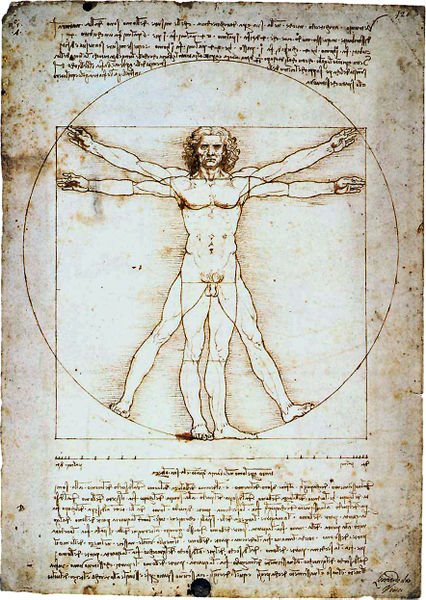
I was at the gym last night, re-reading the first section of W.G. Sebald's The Rings of Saturn (which I have been trying to read for six months, but have been unable to finish because all previous reading was done either on the train, at lunch or while riding an exercise bike — none of which I have been able to do for quite some time, due to the lack of a free gym or a need for public transportation at my current abode... and the complete and utter lack of actual breaks at work) when I revisited this passage about a man who saw crystalline shapes everywhere. And then I thought of Leonardo Da Vinci, and that circle he drew around man.

It was about then that I realized the power of cliches: that everything really does come full circle. That everything is somehow connected, even if by chance. That sometimes words that piqued our poetic sensibilities once upon a time are very much alive and well... in the most parasitic, ineffable way.

I'm reminded now of high school geometry. I'm reminded of those postulates and hypotheses... and how all of our theorems were just a few steps away from "living" proof (or in a word: conclusion).

Which begs the question: when did I get into this mess? And how, on earth, does it end?

Wednesday, October 18, 2006

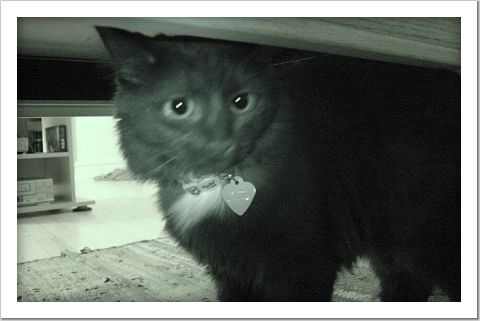
Diary of a Crazy Cat Lady


Pet ownership is not at all what I remember it to be.


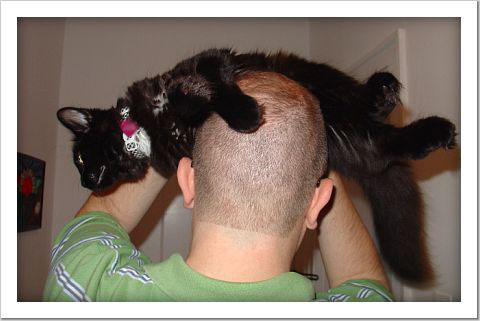
But this may have something to do with the fact that the only indoor cat we ever had growing up used my father's head as a litter box early some mornings (and so the era of "indoor cats" was substantially short-lived).

Most of our cats lives were short-lived, for that matter. We lived in a rural area replete with racoons, possums, coyotes and even foxes (not to mention, the usual dangers posed by man: speeding cars, drunken hunters, etc). I hate to say it, but I don't recall a single cat living past three years of age. And even that may be stretching it.

Our dogs usually got a little better treatment. We did have one get shot by a hog farmer (I was only seven or eight at the time and was TERRIBLY traumatized by that). After that, we started to tie them up, a procedure which inflicted an entirely new degree of horror on a girl with an almost unhealthy degree of empathy for animals. Shortly thereafter, we got our first "strictly indoors" pooch... a cocker spaniel who enjoyed life well into her teens.

But somewhere in-between, I witnessed all varieties of pet tragedies; one cat, for example, died defending her kittens from a predator (a tom cat or a possum — hard to tell for sure). I spent that summer bottle-feeding her litter, only to lose the runt (who was also blind) early on to an end I'd rather not mention; and still another to a local boy my mother gave two of the kittens to one day while I was at softball practice (they still needed to be bottle feed at that point — something he was not prepared to do). I cannot even begin to express how angry I was with my mother when I returned home to discover the missing kittens... and how nauseous I felt when he brought one of the kittens back several days later... she was emaciated and sickly, and weighed less than half what she had when she was in my care. It took great attention to get her back into shape.

[Which I did, only to later have her get run over when my parents refused to let me bring her indoors.]

I was maybe nine at the time. And the incident was just enough to transform my empathy for animals into an almost disheartening sense of despair for life in general. Suffice it to say, that was not a good summer.

Aside from incidents such as that, pet ownership was generally "easy." You fed and watered them, and you snuck them inside when your folks weren't looking. But predators were always a stressful concern.

So when Maude came to live with me, I thought having an indoor cat would be a veritable peace of cake. Aside from the inevitable concerns associated with big city landlords, there are no predators in my apartment to speak of. I keep the place clean, so there's unlikely to be a bottle of poison enticing her on the floor, and I'm careful to only leave out "safe" toys when I'm not at home.

But I've since determined that I may very well be cursed when it comes to pet ownership. Though Maude is alive, healthy and well to this day... she's in such a state despite herself.

Regular readers likely recall the ponytail holder incident that cost me just over a grand. And while I don't want to jinx myself by admitting that nothing so awful has transpired since then, we haven't been without close calls.

Here's a snapshot of Maude's day-to-day:

  • Maude regularly sneaks into my shoe closet, and my clothes closet, when I'm selecting the day's wardrobe. She does this quickly, and unnoticed, which has resulted in her being shut in the door once, and repeatedly locked inside for 5-10 minutes at a time (luckily, she loves being in there, and I always look around for her after a sustained period of silence)
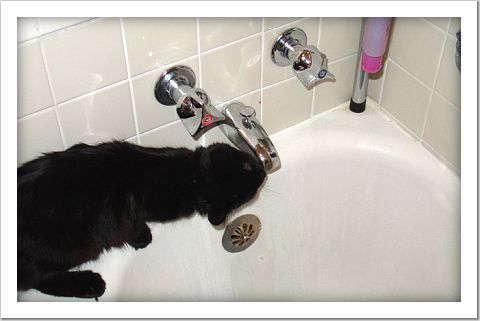
  • Ever since the ponytail incident, she refuses to drink water from a bowl. She now only drinks from the faucet or — if I don't leave that on for her — a water fountain made especially for weird cats like her
  • As a result of this quirk, she's taken to jumping up on my kitchen counter to catch water dripping from the faucet. Clean freak that I am, this grosses me out and has resulted in a substantial increase in the amount of time I spend cleaning the kitchen
  • One night I woke up to this awful screeching sound. I ran into my living room, only to discover one of Maude's toys in the water fountain; it had soaked up ALL OF THE WATER, and so the engine was in the process of burning out. (She throws her toys in the air, sometimes for great distances... I imagine she was attempting to disembowel her stuffed polar bear when the incident occurred)
  • Because of some unusual post-op behavior, we suspected Maude had a touch of taxoplasmosis, and so I spent the last month giving her an antibiotic, twice a day (turns out she probably was NOT a carrier, but with my sister being pregnant, I didn't want to risk it). Ever given a cat a pill? Not fun at all.
  • While I keep the number of "treats" to a minimum, since they're mostly for adult cats, I was giving her the occasional treat as a thank you for swallowing the pill. One morning I didn't do this, and Maude contested by disappearing for over 30 minutes. I searched my closest and under the bed before leaving (I ALWAYS make sure I know where she is before I leave), only to later find her just sitting in her covered litter box. She refused to come out until I opened the bag of treats.
  • Last week I returned home only to discover three piles of vomit on three different rugs. I immediately panicked, wondering if she'd discovered a stray ponytail holder again. She seemed OK... but then vomited again an hour or so later (again, on three separate rugs). I made an appointment with the vet, but then cancelled after she successfully ate (and digested) food.... much to my relief.
  • I discovered a possible cause for her upset stomach a day or two later when my stereo delivered deplorable reception. There were little bite marks up and down the wire antennae, and she'd even succeeded in gnawing all the way through one part of it (not to mention the speaker wires — only one works now). I must've forgotten to spray these wires with Bitter Yuck, because I doused all other cords with the stuff several weeks ago (when she first showed an interest in electrical things)
  • This week I awoke to the sound of her playing noisily in the hallway; I decided I was thirsty anyway, so I got up and went into the kitchen... only to see a beloved post card (previously on my fridge) sitting on my dining room floor, the corners of it chewed away. The magnet that had been holding it there was in the hallway upside down... it had a few teeth marks in it, but apparently didn't meet with her tastes and so was otherwise unscathed.
  • When I mop, Maude does one of two things: sticks her head into the mop bucket and displays a level of curiosity that borders on "Hey, I wonder if I should try that water!" OR she runs across the freshly mopped floor, slides... and then licks the cleaning agent from the pads of her feet. Maude now hates it when I clean, as I have to lock in various rooms as I mop elsewhere... I'm not sure, but I suspect Murphy's Cleaning Oil isn't good for kittens.
  • She weighs less than five pounds, and yet takes up half the bed. She gets right up next to me, and I'm terrified of rolling over her. So I remain in the same position, pushed to the side, before she gets up after her "cat nap," starts making a ton of noise playing with things that aren't toys... and gets kicked out of the room (at which point she entertains herself for awhile, but then comes back to my bedroom door and paws at it — no claws out, luckily — until I let her back in).
I could go on, but this post has already overstayed its welcome. Essentially, I'm starting to see an entirely new world of dangers in my comfy little apartment, and I'm terrified Maude is going to succumb to an untimely end I had previously assigned only to outdoor cats.

For this reason, I now check my floors multiple times (for ponytail holders and such) before I leave for work or go to bed; I sometimes walk back into my apartment after locking up because "I can't remember" if I shut the closet door; and I regularly rearrange furniture to minimize the number of exposed electrical cords.

In short: I've become quite OCD, compliments of Maude.

And to those of you out there who encouraged me to get a cat — to those friends, family and co-workers who said indoor cats were "easy" to take care of, and too smart to cause any real trouble —

I'm holding you all responsible for this. Your bill is in the mail.

Tuesday, October 17, 2006

Stop Looking Down

Monday, October 16, 2006

Sleep Perchances a Dream

While I did look up The Science of Sleep's overall "rotten" rating before watching it... I didn't read any of the reviews. Suffice it to say the 69% rating it received had me expecting a mild to moderate disappointment. And the very anticipation of disappointment was, well... disappointing.


Michel Gondry's previous feature film, Eternal Sunshine of the Spotless Mind (2004) is among my favorites (I know, I know... I've already made that known countless times on this blog). And if I had the impression there'd be any use in a Top Ten list, Sunshine would most definitely be on there (though, to be fair, my "top ten" would likely include no fewer than 20 films). So the mere thought of a D+ average for Gondry's newest had me crestfallen.

Much to my surprise, then, I actually enjoyed The Science of Sleep (2006). I wouldn't put it up there with Sunshine, though it is the sort of film I'd recommend to my friends. It's whimsical and charming. And the stop motion animation throughout is the sort of imagery that leaves a smile on your face.

But that's not to say it's altogether flawless, and I can see why some critics are hesitant to dish out heaps of praise: it lacks the depth of plot that made Sunshine so compelling (perhaps Gondry could've used Sunshine co-writer Charlie Kaufman on this project as well). And it's difficult to pinpoint an actual "purpose" for the film. Is it about a man recovering from his father's death? Is it about his reconciliation between his French and Mexican parentage? Is it about a dreamer at odds with a cubicle world?

Or is it, as most of the trailers lead us to believe, a movie about a boy who likes a girl who doesn't like him back even though they're clearly meant to be together?

Before I hazard a guess, it may be worthwhile to note that the one thing I hate about writing fiction for a critical audience is the assumption that everything must have a point... that there must be a central focus; rising action; falling action; etc. While it's true that, at any given point in our lives, we may be preoccupied with a particular event, said event is seldom the only thing that drives our thoughts. Rather, every day is a compilation of catalysts and consequences that propel us further towards (in-) action.

It always struck me as unfair that a story, then, could only have one purpose. Or even that it should have any purpose.

Am I saying the The Science of Sleep is without focus?

No. I'm just saying I wasn't so much concerned with finding, dissecting it, and pinning it to a wall. Not to mention, a movie that deals so much with the variegated nature of dreams should, itself, be a patchwork of sorts.

And so The Science of Sleep paints the dreamworld of its main character, Stéphane (played by Gael García Bernal). Stéphane is a 20-something artist who falls so deeply into his own dreams that he often fails to distinguish them from reality. The end result is a film that, itself, switches between dreams and reality, often transitioning so fluidly that even the viewing audience is unable to tell one from the other (this, in part, because Stéphane has painted a reality for himself that somewhat imitates his dreams — where water is made of cellophane; cities are made of cardboard; and trees ride freely aboard ships).

For this, Stéphane reminds me a bit of Jean-Pierre Jeunet's Amélie. He's inventive and creative, and does just about every beautifully imaginative thing to capture the attention of his next door neighbor. He evinces the sort of childlike charm that most of us abandon with time: and this charm appears in his dreams; in his reality; and his sometimes painful struggle to separate the two.

In fact, as the film progresses the very thing that makes Stéphane so appealing bears the unfortunate side effect of bordering on mental illness. That is to say, Stéphane seems perfectly normal in the beginning — just a bit quirkly — but we eventually (and subtly) come to realize there's more to it than that. He ultimately suffers for his 'beautiful affliction.'

The end result: a string of surrealistic images that could have benefited from a bit more glue to hold them together (yes, I admit, this film is missing something). But, man, if it wasn't pretty while it lasted.


NOTE: About 1/4 of the film is in French; be prepared to read subtitles.

Friday, October 13, 2006

Tristram's Shanty

Though I wouldn't necessarily nominate it for any awards, I enjoyed Tristram Shandy: A Cock and Bull Story (2005) substantially more than did my movie-watching companion. I found it to be clever, and witty, though at times difficult to follow (this likely owing to the fact that I watched it over the course of four different meals, spread throughout a week).

This "mockumentary" isn't so much based on the early 18th century satire, Laurence Sterne's The Life and Opinions of Tristram Shandy, as it is a pseudo-documentary about the process of filming a movie based on the book (HUH?!). I appreciated this technique insofar as it underscores all that can go dastardly wrong when compelling novels are adapted for the big screen. And by that I mean: this film takes you "behind the scenes" in the faux-filming of an adaptation.

I should add that Tristram Shandy, the book, is one of my favorites from the 18th century. It's up there with Henry Fielding's Shamela in terms of anachronistic comedy (both novels were well ahead of their time). And, as the "actors" in Tristram Shandy, the movie, frequently lament... Tristram Shandy, the novel, is so complex — and so full of time jumps — that it's nearly impossible to film. The mockumentary setup, then, is perfect for the material.

Rather than attempt to condense a 700 page novel into 2 hours — or bowdlerize it at will to make it Hollywood-savvy — the film "adaptation" of Tristram Shandy is done with the same sort of wit and craft that made the novel such a joy to read. But it does this, of course, without really telling the story of Tristram Shandy.

Oh, mockumentaries. They're so very difficult to explain. Allow me to try again:

Tristram Shandy, the movie, is the fake documentary about the filming of an adaptation of Tristram Shandy, the book. It makes no attempts to imitate the novel, per se, but somehow derives from the same sort of humor the original text is known for. In other words: the film exercises a degree of charm and wit that sufficiently recreates Sterne. It does this by satirizing the very attempt to turn the novel into a film, and frequently jumps to the "behind the scenes" lives of the actors (playing themselves) playing the characters in the novel.

You know those "Making of..." special features on all the DVD's these days? Tristram Shandy, the movie, is like that... the whole way through. It's the main feature, and it's all fake. Get it? No?

I don't blame you.

Also of note — for those of you unfamiliar with British film — I should caution that they're much more, um, forthright when it comes to "tastefully" showing various anatomies you rarely see in American cinema (not the kind you'd watch with your folks, anyway). It was for this reason that the aforementioned movie-watching companion threatened to not finish the film — unless they started giving women equal "screen time."

(A protest which seemed to only further my amusement.)

Sigh. No matter how many times I attempt to explain, I can't quite seem to capture the film's raison d'etre. Watch it... and you'll know what I mean.

Tuesday, October 10, 2006

I Know Why the Caged Mule Neighs


Monday, October 09, 2006

Study of the Midwest in Motion


Wednesday, October 04, 2006

Haiku/Gesundheit (Volume XXXVI)

on taking my second lunch break in three months

this is what i call
the quiet before the maelstrom
breath found and then lost


on seeing three cop cars arrive at wal-mart just before midnight

this is contrary
to everything he stands for
elmo says be nice
people around here have too much money

when i think 'rolls royce'
i don't think 'bumper stickers'
that looks tacky, man
nothing screams irony quite like a missed photo opportunity

i stand with george bush
(sign beneath an advert for
'annihilation')

Tuesday, October 03, 2006

Portrait of a Dry Erase Board

Friday, September 29, 2006

Hero

"And that's your father when he was a police officer," she said, pointing to a newspaper cutout of her son.

"Why was he in the paper?" the four-year-old asked.

"Well, you see that girl?" She points to the teenager standing awkwardly next to her son, decked out in his blue uniform.

"Yeah."

"Well. Her house was on fire, and your daddy got there before the fire department. So he climbed the tree outside of her window, pulled her out of the window and carried her down the tree."

The four-year-old gasps, smiling so big his eyes almost shut. He sucks in a gutful of air and tries to speak.

"My dad's a SUPERHERO!!!"

He jumps up, does his best Mr. Incredibles impression, and then sits back down, putting his hand on his grandmother's knee.

"Show me more pictures, Mamaw."

Wednesday, September 27, 2006

Turtles an Oscar Oversight

If you allow that we went into Iraq too late, too clumsily, and for all of the wrong reasons...

That still doesn't detract from the fact that Saddam Hussein is responsible for some terrible atrocities. I remember the first time I saw a photograph from Saddam's 1988 "campaign" against Kurdish Iraqis. It looks a little like this: a baby, maybe 6 or 7 seven months old, wrapped tightly in a pretty blanket. Mouth frozen open, head thrust back. And the body of his/her mother extended atop. As residents in Kurdistan, they'd been victims of poison gas attacks orchestrated by Saddam's regime.

But that was one of the more "peaceful" deaths afforded to this ethnic minority during the 1980s. In many instances villages were raided, civilians were slaughtered, and the children left standing were generally orphaned.

And that's what Turtles Can Fly (2005) is about. Kurdish children displaced by Saddam's army (though if we are to believe the chronology, much of the inciting action took place in the late 1990s); most of them without parents and many, even, without aunts, uncles or even grandparents. They're alone at a refugee camp near the Turkish border, and so build a network wherein they look after each other. The oldest of these kids, Satellite (Soran Ebrahim), is essentially the leader of the pack.

He's bossy, a braggart and generally quite annoying for the viewing audience. But the younger kids look up to him and, when you get right down to it, he genuinely cares for them and even risks his life, on more than one occasion, to save one of "his kids."

You can't help but like Satellite as a result. Even as he insults the armless boy or lies to the village elders... even as he shouts for the little kids to help him build bunkers, and barters for weaponry. You see all of this and remember that he, himself, is just a boy in his early teens.

And because this movie focuses on Kurds in Iraq, I appreciated being able to see the American invasion through their eyes. I mean, when you consider the sort of torture (both literal and metaphorical) the Kurds had been subjected to because of Saddam, wouldn't the Kurds in Iraq thus anticipate the arrival of American forces?

Iranian writer/director Bahman Ghobadi provides a subtle answer to this delicate question. Americans are neither demonized nor glorified in Turtle (this movie isn't about them, remember... it's about these children). And it's true that many Kurds were so eager to see Saddam removed from power that, yes, they were excited to see the American tanks come
rolling in.

But that excitement was tempered by a much harsher reality: there were still American-made mines buried by the hundreds (thousands) around the Iraqi countryside... all remnants from previous conflicts. And these mines were often "discovered" by Kurdish children. So what does this "welcome" invasion mean for them?

You sort of get a sense that these people are the victims of dictators and "peace keeping" forces alike. They're in the middle of a conflict that is exacerbated, rather than mollified, by a seemingly endless cycle of wars.

There's also a fairy tale subplot to this story, as rumors circulate about a boy who can see the future. But this subplot is so beautifully woven into the main story line that it actually becomes believable. Add to that this film is oftentimes charming - even comical - and you can't help but think that a film about children should be for children.

But there's much more to this story, and Turtles Can Fly emerges instead as a message for the rest of the world.

Last Kiss Needed More 'Scope'

The Last Kiss (2006) wasn't awful but, given my current time crunch, I don't exactly feel compelled to dedicate much energy to reviewing it, either.

It was... OK. Not as good as Zach Braff's previous film, Garden State (2004), but not as bad as some of the other piffle I've reviewed here. I'd put it up there with The Break-Up (2006) in terms of movies that offer a semi-accurate portrayal of relationships (which compares to most romantic comedies), but I also enjoyed The Break-Up more than I enjoyed The Last Kiss.

So what's missing?

Retribution.

I don't mean fire, brimstone or any other such dark force of vengeance. Just... a sense that, much as in reality, things cannot always be mended.

And so while I appreciate that this film shows what many people "do," I don't like the implication that everyone "does" it (ergo: everyone ultimately deserves to be forgiven).

I suspect many other females will be likewise annoyed, in which case I'd caution less-than-blissful couples against watching this together. It's better reserved for movie night alone at home whilst adorning your voodoo doll with shiny, multicolored pins.

Friday, September 22, 2006

The (Not-So-Great) Pumpkin

After four years of tranfsferring Pumpkin (2002) from one "Movies to Watch" list to another (I tend to carry such lists in a notebook, which gets quite tattered over the course of time), I was a bit disappointed to find it full of stock characters and humor that, while dark, preyed a little too much on annoying stereotypes.

Sure, I can handle the occasional I.Q. joke. But when you take a group of mentally handicapped young men and turn them into caricatures of indiscernable ailments, my stomach turns a bit. One of the biggest "gags" in this movie, for example, consists of a photograph of the title character looking - for lack of a better word - "goofy" (hair tussled, crooked grin, exaggerated features, etc.). Every time that 8 x 11 close-up is on the screen, you want to laugh. And I hate that.

Ditto with Reese Witherspoon's character, Carolyn McDuffy. She was such a cardboard cutout of everything that's wrong with sorority girls that I almost felt sorry for decent sorority chicks out there fighting against the perky, unintellectual materialist stereotype represented by Carolyn.

But, wouldn't you know it... Carolyn has to work with Pumpkin for a sorority house "charity" project, and she falls madly in love with this "creature" she can't understand.

At which point Carolyn rebels against her sisters as she starts sees them for who they "really" are. She then - GASP! - expands her horizons all the while making otherwise poor decisions.

I actually like the idea of this movie; add to that Pumpkin qualifies as a dark comedy, and it's not hard to understand why I've maintained such an interest in seeing it. But the actual experience of watching it did not meet with my expectations. That is to say: it's not so much a "smart" comedy, as it is an annoyinhg parody of itself. An exception to this is at the very end, where Pumpkin almost redeems itself with a simple glance over a shoulder. If you've seen the film, you know what I mean.

So is this a case of a horrific film, or an OK film at odds with high hopes? It's somewhere in-between, though if you - like me - are the sort of geek who keeps "Movies to Watch" lists... don't fret if you forget to add Pumpkin to the updated version.

Thursday, September 21, 2006

In Search of Zerzura

"But nothing's lost. Or else: all is translation // And every bit of us is lost in it... " ~James Merrill, "Lost in Translation"


If I had had my camera while jogging tonight, here is what I would show you:

A twenty-something couple out walking their dog:

When they stopped on the grass for a bit, they sort of reached in for each other and embraced while the dog ran circles around them. The dog was on a leash and every so often I'd think the couple was about to find themselves lost in a mess of rope... but then something would happen and they'd somehow spin themselves, in unison, right out of the mess. The dog kept running around them.... And they never stopped holding on.

At the risk of indulging too greatly in the saccharine, I must admit: that was one of the most beautiful things I've ever witnessed between two people. So much so, in fact, that I had to look away.

Shortly therafter -- as I took a break midway through my jog to stretch, think, and observe -- I saw five people, all of them elderly, looking out over the water. Two were in wheelchairs, which afforded the moment a supplemental degree of poetics.

I mean... I'm watching these people watch (really watch) the water. And I'm watching as two of them push the others back onto the path, their thin white hair stirring as they twist away from the tide.

That's when it hit me.

When I finally leave this city, I'll miss the lake most of all.

Sometimes watching it -- and observing city-dwellers gather around it like nomads in search of Zerzura -- I'd swear it were the ocean.

There's something to be said for that. Something to be said for finding a momentary oasis in this city of smoke, steel... and cold shoulders.

Wednesday, September 20, 2006

The Naming of Children

A conversation between my 4 1/2 year-old nephew and my sister, as relayed to me by the latter.

Nephew (Leaning onto a Counter): So. What are you going to name the baby boy?

Sister: We don't know yet. Do you have any ideas?

Nephew (Deep in Thought): Well, I'd say "Luke," but that's what I named my lion. So that's definitely out of the question.

Sister: Yeah, I suppose so. Any other ideas?

Nephew (Deeper in Thought): How about "Obi Wan"? That's an honorable name.

Sister: That is a very honorable name, but I'd worry the other kids might make fun of little Obi Wan.

Nephew (Sighing): I guess you're right. Some kids make fun of little babies.

Tuesday, September 19, 2006

Study of a Rainy Afternoon

Saturday, September 16, 2006

Portrait of a Dining Room Wall

Wednesday, September 13, 2006

Potty Till the Cows Come Home

Senator Lincoln Chafee won the Republican primary in Rhode Island, which has some folks very excited. You see, Chafee has a history of not supporting President Bush, which generally upsets his fellow Republicans.

But I mention this not to continue the string of politically petty posts I've added to this blog in the last week or so. But, rather, because I first heard about this news on NPR this morning, when a Chafee supporter slipped into his thick Rhode Island accent and — I swear — said something to the effect of "Chafee cuts through the potty lines."

Now, I realize he actually said "party," and it's very un-p.c. (not to mention juvenile) of me to find humor in someone's accent.

...But I'm doing it anyway. It made me laugh. I can't help that.

Tuesday, September 12, 2006

Trafficking

By far, my commute home from work is generally the worst part of my day. And my commute to work is usually the second worst part. There are, at times, horrible exceptions to this. But this is almost always the case.

As a result, I generally arrive to work irritated, and I return home angry. What happens in-between fluctuates day-to-day, but has been especially chaotic the past 2-3 months.

But back to the issue at hand: trafficking. The ordeal that bookends my day, raises my blood pressure and generally robs me of any remaining shred of faith I might hope to harbor for the human race.

A city-to-suburb commute is generally an awful experience. And I'd strongly urge all of you to never regularly engage in such a dehumanizing ritual.

Think I'm exaggerating? Maybe I am. Below I'm recounting actual encounters from the last 24 hours. Tell me what you think.

To Work

  • A woman attempts to cross at a crosswalk where she has the right-a-way. A man in a truck waiting to turn left determines man law trumps traffic signs and proceeds to honk at her. She begins to run. He flips her off and squeals his tires the moment he has enough room to get by.
  • A cabbie decided to park in a lane that doubled as the right lane of traffic. I was in this lane. I see the cab in enough time, I think, to signal and get into the left lane. The car some four car-lengths behind me in the left lane sees my signal, speeds up, and prevents me from getting over.
  • One lane on a major city street is closed down for sidewalk construction during the mourning [SIC] rush hour. I wait quietly while some honked and gestured, as though that would get us anywhere faster. It took us 15 minutes to travel three city blocks.
  • A big part of this delay, for the record, is that cars in the right lane waited until the last minute to get over — despite repeated warnings that the lane was going to end
  • Just before the expressway exit, while still on a city road, I'm stopped at a traffic light in a lane that is both for those going straight, and those turning right. I'm going straight. The man behind me wants to turn, and so honks his horn for me to go. Mind you, the light was red.
  • I'm in the right lane just before the exit to get onto the ExpressWay. The lane to the left of me is NOT an exit lane — it's for those continuing straight on the city street. During mourning [SIC] rush hour, that lane moves considerably faster than the one I'm in. And yet cars in the left lane will speed ahead of the line, and then cut in front of others who had patiently waited in the right lane. This happens daily. Today was no exception.
  • Much closer to work, I wait five cars behind in the right-turn lane for those folks in the left-turn lane in the opposite direction to no longer have the green "turn" arrow. My light turns green, which means theirs is red, and yet people continue to turn left as though traffic had suddenly become a game of follow the leader. This continued long enough that I did not get to turn on the first green light.
  • Between the time I left for work, and the time I arrived, 65 minutes had passed (in all fairness, the construction really put me back — generally the mourning [SIC] commute is closer to 50 minutes]. If you're keeping score, I live 20 miles from where I work. I averaged, then, about 18.5 miles per hour.
In-Between
An exception to the 24-hour rule, as this happened Saturday but is nevertheless vital to understanding my daily frustrations with traffic mentality.

As I entered a parking lot, a man's car stalled in front of me. I stopped and waited. He started his car again, continued forward, and it died again. He motioned for a woman to go ahead (she was exiting from the direction opposite him). She motioned for him to go ahead. He was visibly frustrated and motioned again, then pointed to his car. Just when she finally caught on, a guy in a white Jetta behind me honked for me to go. Mind you, with this oblivious woman in one lane and the stalled man perpendicular in front of me, I couldn't go. And because I felt badly for the guy in the shoddy car, I wasn't about the honk at him. My stomach burned with an immediate distaste for some anonymous guy in a white Jetta. The guy in the stranded car looked at me — probably thinking I was the one who honked. I looked back and sort of waved to try and let him know I hadn't. His car started, and he sputtered out.

From Work
  • They started work on the ExpressWay yesterday, and reduced three lanes to two. They don't say how long it's expected to last, but for the two miles prior to the construction, I was moving at about 5-10 mph. Luckily, traffic picked up considerably after the third lane opened up.
  • During this insufferable jam, I became obsessed with a hideous mural on a bus: the caricature of a train conducter, with his big cartoonish face smiling at me from the backside. He looked like a demon-possessed nutcracker that may very well come to haunt my dreams.
  • City side streets that are two way are often very crowded with parked cars. When someone approaches from the opposite direction, both generally slow down and pull in closer to the parked cars. Occasionally, someone decides to not obey that etiquette, and you're at risk for a reasonable side-swipe. Yesterday I had a close call.
  • It's also generally accepted that, when you park in the city, you check your side mirror and peer over your shoulder before you exit the car (I sometimes sit in my car for a considerable period, just waiting for the opportunity to exit). Some people don't get this and, shortly after the aforementioned, a chick in a parked car decided to open her car door WITHOUT checking. She did this just as I approached her. Luckily, no one was coming in the opposite direction, and I was able to swerve to miss her.
  • This city is replete with roundabout intersections. These are tricky when turning left because, legally, you are supposed to go AROUND the roundabout to turn and NOT cut in front of it. I obey this rule, but I'm starting to realize that most don't. Not to mention, most are so ignorant of this that they'll even cut me off as I go around it to turn left. Yesterday as I searched for parking, I was cut off twice.
  • Parking in my neighborhood sometimes means either parking three blocks away [three blocks away of the direction I need to go in the morning OR three blocks in unsafe territory], or driving for 5-15 minutes until a space opens up. Sometimes I get lucky and find something on the first shot. But often, as with yesterday, I'll turn around in an alley when I see something open up, only to have someone "beat me to it."
  • Remember, this commute is 20 miles. And yet my return trip, including the search for parking, took 85 minutes (or 14 miles per hour). That's about average, though sometimes the trip takes considerably longer.
Once Home
Once I find parking and go inside, I try my darndest to not leave again — not in my car, anyway. It's more difficult to find a non-meter spot as the night wears on and, even though parking on the main thoroughways becomes free after 9 p.m., you have to move your vehicle by 6 a.m. when they (claim to) "clean the streets." This lesson cost me $50.

"R & R"
Generally when I return home from work, I spend a few minutes catching up on blogger while tending to an attention-deprived cat. If I didn't workout in the morning (which seldom happens these days), I do so after work. This helps work out any aggression, but at times my efforts are halted by other "obstacles," shall we say.

Yesterday's obstacle: after coming into my apartment three times in the last week and a half (once without asking permission), my landlord had sent someone again to address (and re-address) the same two issues: a broken lock on my back door, and a window that was broken when I moved in. When I returned home yesterday, I was met with the following:
  • My front door was unlocked
  • Assuming someone was there, I called out. No one answered.
  • I noticed the blinds were askew in every room, which meant they'd been searching for the broken window (I told them exactly where it was)
  • I proceeded to the living room, where the cracked window was, and noticed it wasn't fixed. Not expecting, then, for there to be glass on my floor, I moved in to pick up a piece of broken wood.
  • I then stepped, barefoot, in glass.
  • Maude approached me. I shouted for her to get back, realizing then that there'd been broken glass on my floor for possibly 2-3 hours. She'd been loose the entire time, and I started to panic that she may have walked in it as well.
  • I locked her in my bedroom and proceeded to clean up the mess while on my (now sandaled) tip toes.
  • Why my tip toes? — Because I had glass in my right foot. That's why.
  • After sweeping up the bigger pieces, and then running a damp cloth to try and pick up the smaller specks, I let Maude back out and proceeded to the bathroom, where it took me 30 minutes to extract a very small piece of glass from my foot. I actually wish it'd been bigger — would've been much easier to remove. In actuality, I'm not sure I got all of it out — I heard a crunch and assume I broke a majority of it.
  • I grabbed Maude, who kept licking her paws, and inspected the pads on her feet. She didn't cry when I touched any of them, so I assume (hope) she's all right.
In Sum
This final blurb may have nothing to do with honked horns and middle fingers... but it is a manner of soul trafficking. It's that proverbial "cap" to an experience that leaves an altogether nasty taste in one's mouth. Sometimes after a terrible commute, you just want to come home and relax. But then, sometimes, the city (the parking regulations, the tickets, the crowded streets, the dirty sidewalks, the traffic, the me-first mentality, the living standards, the anonymous landlords) has determined otherwise.

For the record, in the past 24 hours I didn't honk my horn. I didn't gesture or yell. I don't do these things. And even when I called the landlord to request that they just leave the window taped up, I like to think I wasn't mean about it. And later last night, I was gripped with the fear that something horrible had happened to the maintenance guy.

But somewhere, between the traffic yesterday, my experience last night, today's mourning [SIC] commute — and then writing about all of the above — my frustration has transformed into a sort of... embarrassing sadness.

Is writing catharsis, or does it propel us further into a melodramatic, self-righteous abyss?

I confront these questions, and then disregard them, returning to work. Hoping that somehow, somewhere, my doppelganger is smiling.

That makes one of us.