I often compile lists. So often, in fact, that the mere habit borders on compulsive behavior. Here's what I mean: I've not even finished a paragraph, and already... a list of my lists.
- To do lists
- Grocery lists
- Miscellaneous shopping lists
- Must read lists
- Must watch lists
- Do before I die lists
- See before I move lists
- Funny things people say
- Weird things I saw
- And so on
I don't always have the previous list handy and so will start a new one, oftentimes intending to add it to the previous docket once it is found.
This results in a
pile of lists, which can become a tad overwhelming. As with today, when I opened my faux leather padfolio (think: an adult's Trapper Keeper) only to find a fountain of papers spilling over the edges. So I set about to go through the lists and make a NEW list of all the things not yet purchased or done.
In the process, I came across a few "notes to self": my way of saying "add this to the list of things to eventually write about" — the longest list of all and, most definitely, the list that seldom sees items crossed off.
The first was the word "canswer" which, I swear, was the way I accidentally typed the word "cancer" when writing something for work. This happened, unintentionally, several times in a single day, and I remember thinking of all the possible therapeutic uses for such a word.
But
that is not the purpose of this entry (not that I intend any purpose, but that I hope to find one).
No, no... the "note to self" that really got me thinking was — you guessed it — the title of this entry.
Peptoabysmal.
A word which occurred to me one day while nursing a sick stomach. Not a flu or cold or food poisoning sort of sickness, so much as an existential squeeze in one's abdomen. I was experiencing a sustained tug of nothingness, for lack of a better word, and the single, discernible thought that occurred to me was this:
I wish I had some Peptoabysmal.

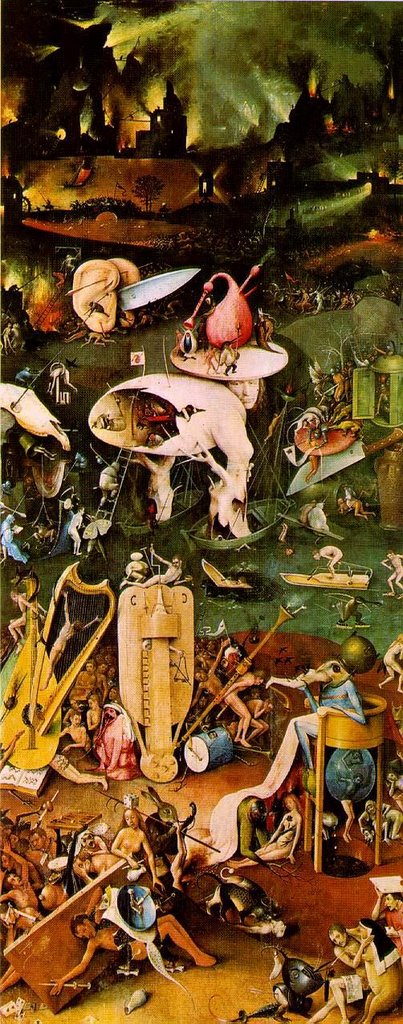
From there, I wrote in my head potential taglines for such a product ("Feeling Empty? Drink Plenty!" or even "Relief for every existential crisis!")... and even had some fledgling ideas for commercials and magazine ads. I imagined characters from a
Bosch painting wandering in to their nearest pharmacy, demanding bottles of Peptoabysmal... and walking away with smiles on their pink-moustashed faces.
But revisiting that note today, I was reminded instead of a poetic obsession I once harbored for words like
ennui,
weltschmerz, and even oubliet. They made frequent appearances in my writing, once upon a time, but now I hazard to think they may very well be realities. I often find myself with nothing to say, even in those rare moments when I have the time to say it.
But this, too, is not the point of this post.
I hope.Instead, let us discuss another word: the first verb I ever invented.
SkepticulateI was 14, maybe 15. However old one is in the ninth grade. We'd been studying Shakespeare and talking about some of those words he created, when we were asked to come up with our own.
Skepticulate occurred to me without pause. So I said as much, and offered a definition.
1. To be lied to so much, you doubt anything anyone says to you.
2. To cause others to lose faith in someone, or something
ant., gullibulateAs in, "The Boy Who Cried Wolf spent so much time skepticulating the villagers that no one believed him when a crisis was near."
There's also the obvious noun form,
skepticulation:
1. The process by which a person gradually begins to question something or someone.
2. The act of skepticulating.
As in, "She would have trusted him, had it not been for his prolonged skepticulation."
But this post isn't so much about
skepticulation, either.
***
I was at the gym last night, re-reading the first section of W.G. Sebald's
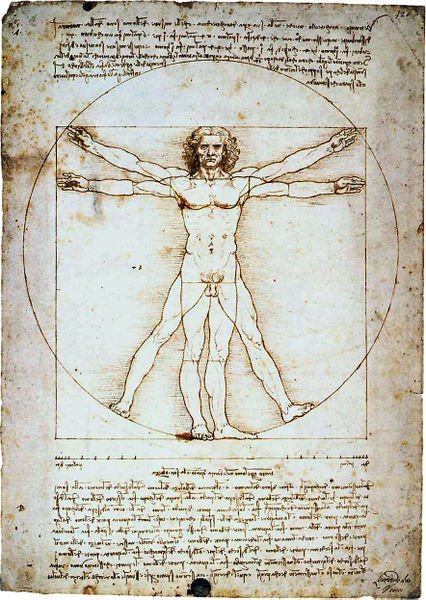
The Rings of Saturn (which I have been trying to read for six months, but have been unable to finish because all previous reading was done either on the train, at lunch or while riding an exercise bike — none of which I have been able to do for quite some time, due to the lack of a free gym or a need for public transportation at my current abode... and the complete and utter lack of actual breaks at work) when I revisited this passage about a man who saw crystalline shapes everywhere. And then I thought of Leonardo Da Vinci, and that circle he drew around man.
It was about then that I realized the power of cliches: that everything really does come full circle. That everything is somehow connected, even if by chance. That sometimes words that piqued our poetic sensibilities once upon a time are very much alive and well... in the most parasitic, ineffable way.
I'm reminded now of high school geometry. I'm reminded of those postulates and hypotheses... and how all of our theorems were just a few steps away from "living" proof (or in a word:
conclusion).
Which begs the question: when did I get into this mess? And how, on earth, does it end?